
Salesforce is now presenting investors with stronger earnings, better profitability and a much lower valuation multiple than two years ago. The comparison has reignited the software industry debate, as investors debate whether the threat of artificial intelligence taking over enterprise software is just a rumor.
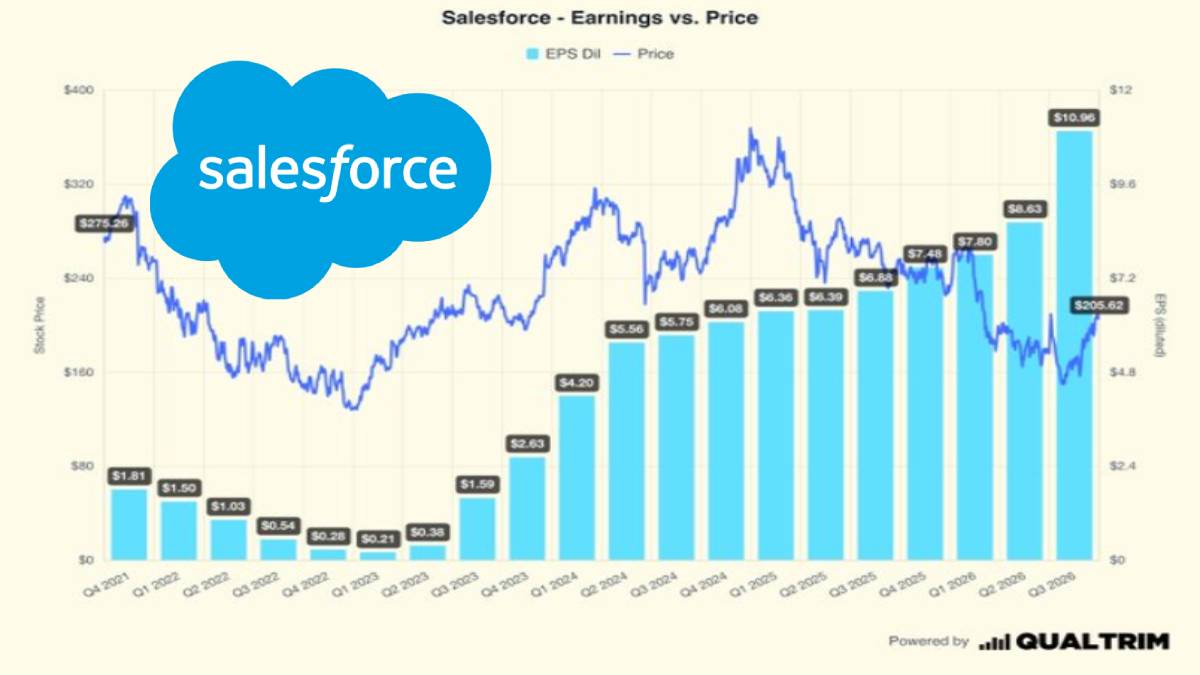
The comparison is compelling. Salesforce was earning around $5.56 per share and around 39 times earnings two years ago. The figures cited by investors are the same: earnings of about $10.96 per share and the stock trades at about 18 times earnings today. So earnings per share have more than doubled and the valuation multiple has fallen by more than half.
That is the core of the repricing story. Investors are paying considerably less for each dollar of Salesforce earnings even though the company's earnings power has increased dramatically.
The latest results provide more context. Salesforce reported a fiscal second-quarter revenue of $11.35 billion, up 11 percent year-over-year, a surprise to Wall Street analysts. Adjusted earnings came in at $5.90 per share, above consensus estimates of $3.27. But most of the profit improvement was due to a $2.53 per share profit from Salesforce's strategic investment in Anthropic. Excluding that investment benefit, adjusted earnings were a bit under $3.37 per share.
But it is also showing that its artificial intelligence strategy is starting to generate real commercial momentum. Salesforce’s Agentforce and Data 360 businesses generated a recurring revenue of almost $3.9 billion from the year before, which is up more than 210 percent. In the last quarter, the company also said its platform processed more than seven billion agentic work units, with 3.2 billion of those being done in the quarter.
These developments are important because AI has been both an opportunity and a major source of investor anxiety for Salesforce. The explosion of generative AI and autonomous agents has raised questions about whether companies will continue spending heavily on traditional enterprise software or rather build more capabilities internally.
Salesforce is trying to turn that threat into an advantage by incorporating AI directly into its platform. The company has just expanded its relationship with Anthropic through Claudeforce and introduced Anthropic's Claude models into Salesforce's ecosystem. That move shows how Salesforce is not just a customer relationship management software provider, it is an AI platform that companies can put AI agents to work on sales, service, marketing, etc.
Salesforce is also very much about shareholder return and financial discipline. Share buybacks have reduced the number of outstanding shares, which can increase earnings per share even when total net income does not rise at the same rate. That dynamic is relevant to the increase in per-share earnings that investors are seeing.
The market's willingness to assign Salesforce a lower P/E multiple also reflects a big change in expectations. At 39 times earnings, investors were paying a huge premium for Salesforce’s growth prospects. At around 18 times earnings, the market is applying a valuation much closer to mature large-cap technology companies.
That doesn’t necessarily mean the stock is undervalued. A lower multiple may mean investors expect slower growth and competition or more disruption from new technologies. Salesforce shares have been under pressure for much of 2026 to sell, in part because investors worried about the impact AI would have on the software industry. It was down more than 20 percent for the year before this earnings report, when the stock recovered from its current low in September.
But the latest earnings announcement seems to have changed the tone. Salesforce shares jumped nearly 14 percent in a post-earnings day on the heels of the company's revenue and profit forecasts and Anthropic partnership announcement. The firm now expects revenue in fiscal 2027 to be around $46.1 billion to $46.4 billion, up from a previous range of $45.9 billion to $46.2 billion. Salesforce also raised its annual adjusted EPS forecast to $16.67-$16.71 from $14.06-$14.12.
The question now is whether Salesforce can continue to grow earnings as fast as it can to justify a higher valuation multiple in the future.
If AI products like Agentforce continue to succeed, Salesforce will likely benefit from a new growth cycle while still generating a lot of cash and shareholder returns. But if growth slows down and AI competition is more fierce, that lower multiple may be an appropriate response to the risks.
For now, the numbers tell an unusually interesting story. Salesforce is earning significantly more per share than it did two years ago, yet investors are valuing those earnings at less than half the previous multiple. That is the company’s challenge— and maybe its opportunity— to convince the market that its earnings growth, AI approach and improving financial performance deserve a valuation closer to the premium levels the company once commanded.
That makes Salesforce one of the more closely watched large-cap software companies as investors reassess the relationship between earnings growth, AI disruption and valuation in the technology sector.






Comments
Please to leave a comment on this article.