
Indian investors are increasingly looking beyond domestic stocks, with $457 million of foreign investor money coming into foreign markets in June—the largest monthly overseas investment of Indian investors. It comes at a time when Indian shares are still behind the U.S. market, and in particular the benchmark S&P 500.
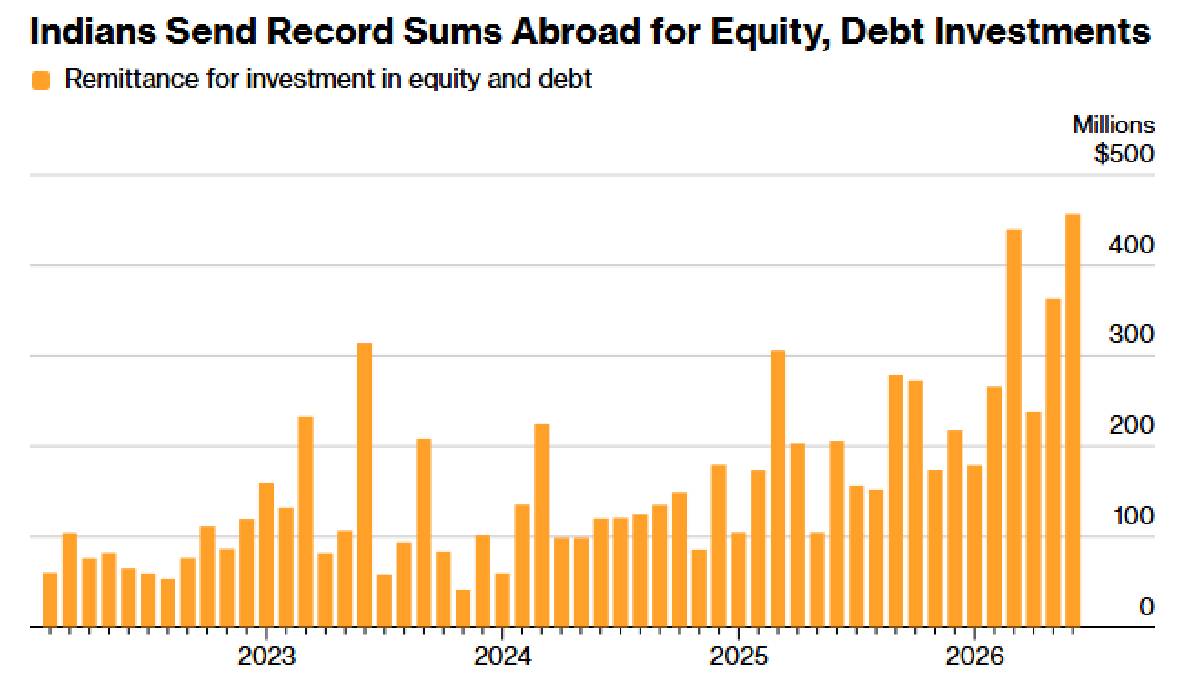
The rising overseas investment is evidence that Indian investors have more appetite for international diversification. While Indian equities remain an important component of domestic wealth creation, global markets offer companies, industries and investment themes that may not be as well reflected on Indian exchanges.
The timing of the overseas investment surge is especially significant. Indian stocks have failed to match the performance of U.S. equities, while the S&P 500 has benefited from growth in technology, artificial intelligence and large-cap firms. So this divergence has revived some speculation about whether Indian investors are in fact turning more into international markets.
I think the $457 million figure stands out not only because it’s so large but also because it happened in the market that it was happening in. A record monthly overseas flow can be interpreted as evidence that investors are becoming more comfortable holding assets outside India. It may also reflect a desire to diversify currency exposure and reduce concentration in a single market.
But calling this development "capitulation" on Indian stocks is a bit too much. Investors moving money overseas does not mean they have abandoned Indian equities. Portfolio diversification, exposure to global technology leaders, currency diversification and looking for attractive valuations can all drive overseas investment.
A comparison to the S&P 500 is still important, though. Investors naturally start to question where they can find better risk-adjusted returns in a market when one market consistently beats the other over a long period. For investors in India, international markets can expose us to companies in the fields of artificial intelligence, cloud computing, semiconductors, advanced software and other new technologies.
At the same time, Indian equities still have structural strengths. India is one of the world’s fastest growing economies and has been supported by domestic consumption, infrastructure expenditure, digitalisation and growing financial participation. The large domestic investor base has also become a stabilising force for the equity market.
The record overseas flow should therefore be viewed as part of a broader transformation in Indian household investing rather than as a vote against Indian stocks. As access to global investment platforms becomes easier, Indian investors have more opportunities to construct internationally diversified portfolios.
An extended performance gap between Indian stocks and the S&P 500 could also be an important theme for the rest of the year. If U.S. stocks keep performing better than Indian stocks, domestic investors could still find overseas diversification attractive. On the other hand, a recovery in Indian earnings and improved valuations or better economic sentiment could encourage investors to return more money to domestic stocks.
For now, it is a striking indicator of changing investor behaviour on the international front when an overseas investment figure of $457 million in June represents a clear sign that Indian investors are more and more inclined to invest abroad and more capital is coming out of the domestic market.
Instead of a total stop when it comes to Indian equities, the trend can be seen as the next stage of India’s evolving investment culture—one in which domestic investors are combining Indian stocks with global stocks and funds in search of diversification, growth and long-term wealth generation.






Comments
Please to leave a comment on this article.