
China’s government bond market is sending a striking signal about investor sentiment, with yields on medium-term government debt still extremely low as investors seek relatively safe assets with the country’s economic outlook deteriorating.
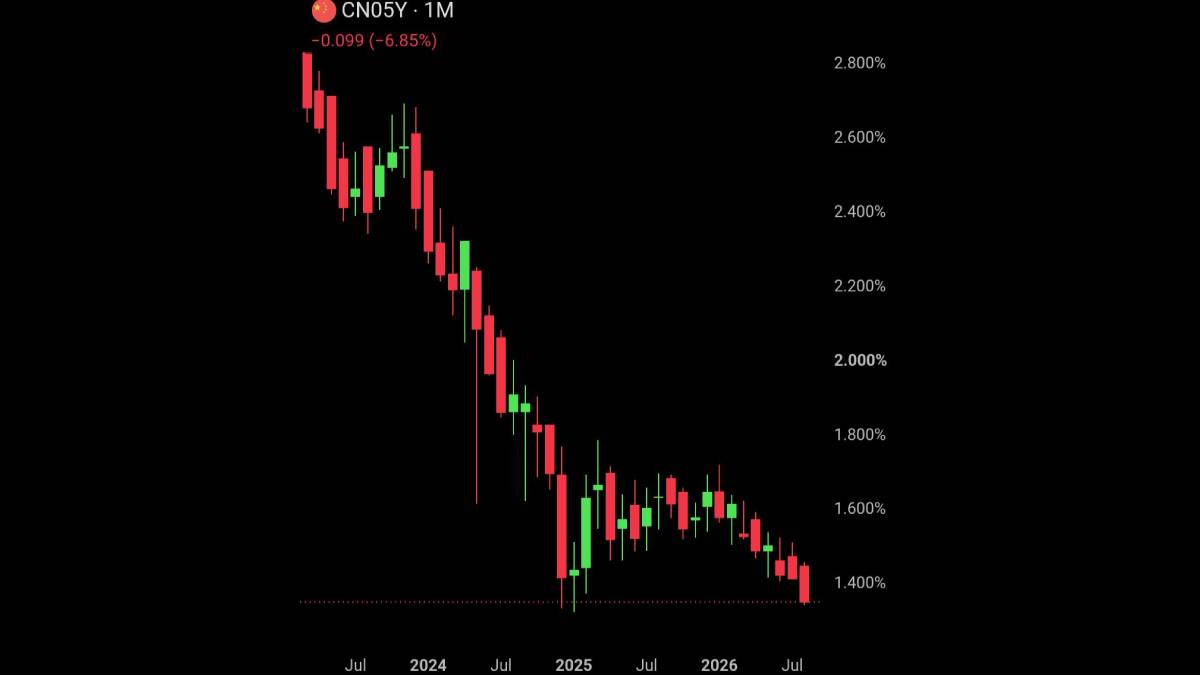
The five-year Chinese government bond yield has fallen to extremely low levels, with recent market data showing yields around the 1.4% range. ChinaBond data showed the five-year government bond yield at 1.45% on July 28, while market data later showed the benchmark around 1.43% in late July.
Bond yields falling quickly in general mean investors are buying bonds aggressively. And when demand for government bonds becomes stronger, their prices rise and their yields fall. But the move in China is much bigger than just interest rates. And it is also tied to expectations that economic growth, inflation and interest rates could remain relatively low.
The property sector is one of the biggest sources of alarm. The World Bank’s July 2026 China Economic Update also showed that housing demand in China is still weak, and sales were still at about half of what they were at the peak level in mid-2021. Real house prices had fallen 23% from their July 2021 high, the report found, and homebuyer sentiment was still cautious based on expectations of further price declines and concerns over unfinished pre-sold housing projects.
That weakness has important impacts on the whole economy. Property has historically been a major source of household wealth, investment and demand in China. Continued weakness can therefore prompt households and institutions to be a bit more cautious about taking risks.
Government bonds are quite a different proposition. They offer relatively predictable returns and carry much lower credit risk than corporate debt or property-related investments. Investors are usually uncertain about economic growth or the future of riskier assets, so demand for government securities can increase.
China's bond market has already attracted international attention as a safe-haven market. Reuters reported in April that China's bond market received about $2.5 billion in foreign inflows during March 2026, even as other emerging markets experienced significant outflows. It cited as a reason for this attraction China's low inflation, relatively stable energy supply and weak consumer demand.
The situation is particularly interesting since very low bond yields can tell two different stories. On the one hand, they show strong demand for Chinese government debt. On the other, they can suggest that investors expect limited economic growth and subdued inflation, and therefore lower interest rates.
At this rate, a yield around 1.4% is really significant. An investor buying a five-year government bond at such a yield is taking a small nominal return in exchange for stability. That decision may be right if you think alternative investments carry greater risks.
The Chinese stock market is another aspect of the picture. Chinese stocks have enjoyed periods of recovery, but investor sentiment is still very much driven by property, domestic demand, corporate earnings and overall economic growth.
It would be too simplistic to interpret falling bond yields as evidence that investors believe China’s economy is about to collapse. Bond markets can rally because of expectations of monetary easing, lower inflation, strong institutional demand, regulatory factors or a preference for safe assets.
The People's Bank of China also plays a major role in financial conditions. The expectations of monetary policy have an effect on bond prices because lower interest rates generally make existing bonds more valuable.
At the same time, China’s policymakers have been trying to stabilize the property market and promote economic activity. As the World Bank reported, authorities had introduced measures for lenders to provide financing for housing projects that could be built in a viable way, to buy up unsold housing inventory and to complete unfinished homes.
The bond market rally will need to be viewed in conjunction with these policy undertakings rather than in isolation.
For investors, the key question is whether China's weak-demand environment will persist or if government measures will restore household confidence, property activity and consumption.
For now, the extraordinarily low level of government bond yields is a powerful indication that investors continue to value safety and liquidity. The bond market doesn’t say China faces a crisis; in fact, it says that expectations for growth, inflation and risk are low.
If yields continue to fall, it could be that investors expect even less demand or more monetary support. If yields continue to rise, a sustained rise in yields could indicate improving growth expectations or a shift away from defensive assets.
China’s government bond market will also continue to be an important indicator to watch as investors consider whether the world’s second-largest economy is moving toward a true recovery—or entering a prolonged period of low-growth, low-inflation conditions.






Comments
Please to leave a comment on this article.