
Zeta Global is no longer just an advertising technology company but an enterprise data, artificial intelligence and business intelligence company. The strategic partnership with Palantir Technologies could be one of the most important pieces in that transformation and Zeta can take advantage of a much larger enterprise opportunity.
The investment thesis is straightforward: Zeta has proprietary customer data, identity, decisioning and marketing intelligence, and Palantir has enterprise data infrastructure, ontology, governance and AI capabilities to utilize these capabilities in large organizations. The companies announced their strategic partnership in June 2026.
Zeta’s Data Cloud is also being rearchitected for Palantir Foundry, it says. They have a plan to be able to integrate operational intelligence, customer intelligence and marketing execution on a single platform. Zeta’s Athena AI platform is at the heart of one such strategy to turn enterprise data into decisions and measurable outcomes.
In Ad-Tech to Enterprise Intelligence.
Zeta has been associated with marketing technology and advertising for years. The platform is used to attract, grow and retain customers from identity, data, analytics and marketing activation.
But the company's recent product development indicates a lot more ambition.
Zeta’s Athena is an AI-based intelligence layer to analyze signals, identify opportunities and take action. Athena is an operating system for agentic marketing, Zeta says; AI not only presents knowledge but also a tool for making decisions and taking action.
That is important.
Business intelligence platforms generally help companies to understand what happened. The emerging agentic model aims to do the same: to understand the data, what should happen next and maybe even to take the action needed in advance.
This will expand Zeta’s reach and the market the company can enter if it moves from marketing departments and into the decision making of the whole enterprise.
Why Palantir Matters
Palantir's relationship would accelerate that transition.
Palantir Foundry provides infrastructure for integrating enterprise data, governance and operational workflows. Zeta also provides proprietary customer intelligence, data, identity capabilities and decision making.
In short, Palantir is the enterprise foundation and Zeta is customer intelligence and marketing activation.
Zeta management has said that the partnership will generate more than $100 million in annual revenue over the next few years. The company also said this partnership will provide it with Palantir customers and a new enterprise go-to-market channel.
This could be important as selling enterprise software through an established platform can be much more scalable than building every customer relationship from scratch.
As for Zeta’s management, recent comments have indicated that Palantir’s existing U.S. commercial customers - including companies spending more than $1 billion annually on marketing - will be a pipeline.
The Data Advantage
One of Zeta's greatest advantages is its own data infrastructure.
The company says its SuperGraph covers 245 million people in the United States, providing a large identity and behavioral database for Athena.
The strategic opportunity is to merge this external customer intelligence with the internal operational data of large enterprises.
And that can create a very powerful feedback loop.
A company might know what is happening in its operations with Palantir but also know its customers and markets with Zeta. AI agents could then go into those two worlds and help decide which customers to target, which products to promote, where opportunities exist and how marketing resources should be allocated.
This is much broader than traditional ad-tech.
Why investors are watching ZETA. Why investors have to know what’s happening in ZETA?
The bullish argument is that the market may still be valuing Zeta purely through the lens of marketing technology and that the company is positioning itself for a larger enterprise AI opportunity.
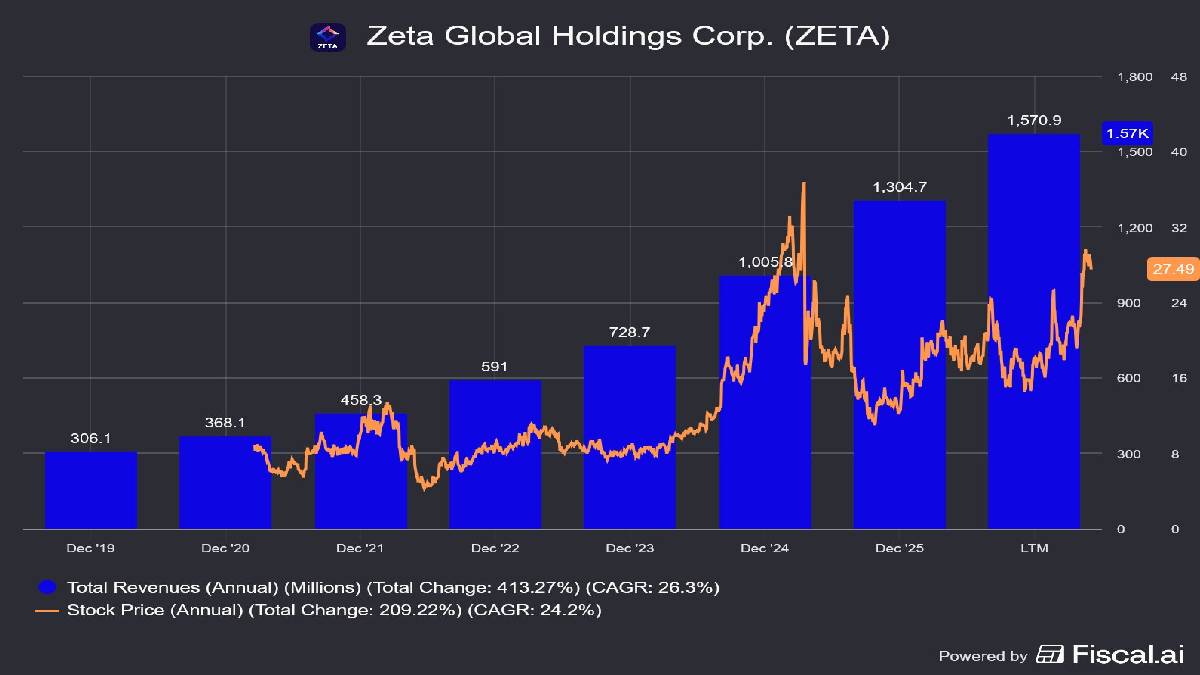
There’s already evidence that Zeta is growing fast. In the second quarter of 2026, the company reported revenue of $442.8 million, up 44 percent from the first quarter and also raised its revenue forecast for 2026 (to $1.818 billion at the midpoint).
The company also announced partnerships with OpenAI and Snowflake, with Palantir also being part of the company’s AI and enterprise data portfolio.
Such a combination may make Zeta an even more interesting name in this AI, data infrastructure, customer intelligence and enterprise software space.
But it comes with risk.
As we have said, the larger opportunity is not the same as a guaranteed outcome.
Zeta still has to show that its enterprise strategy can translate into significant recurring revenue and sustainable margins. The Palantir partnership is strategically promising but partnerships alone don’t guarantee commercial success.
Competition is also something to be looked at. Enterprise AI, analytics and business intelligence are rapidly evolving markets with large technology companies investing heavily.
There is also execution risk. Moving from a marketing-driven platform into enterprise intelligence requires Zeta to show that its technology has the potential to solve mission-specific problems that are beyond the current customer base.
And like any high-growth tech stock valuation and expectations are crucial. Great business growth can lead to disappointing stock returns if investors have already priced in too much future success.
A Potentially Bigger Zeta Story
The most interesting aspect of Zeta’s evolution may not be the existing advertising business, but what happens if the company successfully turns its data and AI capabilities into a broader enterprise intelligence platform.
The Palantir partnership is part of that ambition. Zeta’s Data Cloud is now integrated with Foundry, and Athena is positioned to transform enterprise data into real-time decision making and action.
If the strategy works, Zeta might be seen as not only an ad-tech company but as a customer intelligence and agentic AI platform embedded in enterprise operations.
That would be a much larger opportunity than advertising technology alone.
For investors interested in $ZETA, the question is no longer how fast Zeta can grow its marketing business. It’s whether the company can move from its own data, Athena platform and Palantir relationship to a much bigger enterprise software opportunity.
That transformation is still being developed, but it’s perhaps the most important part of the Zeta growth story to watch.






Comments
Please to leave a comment on this article.