
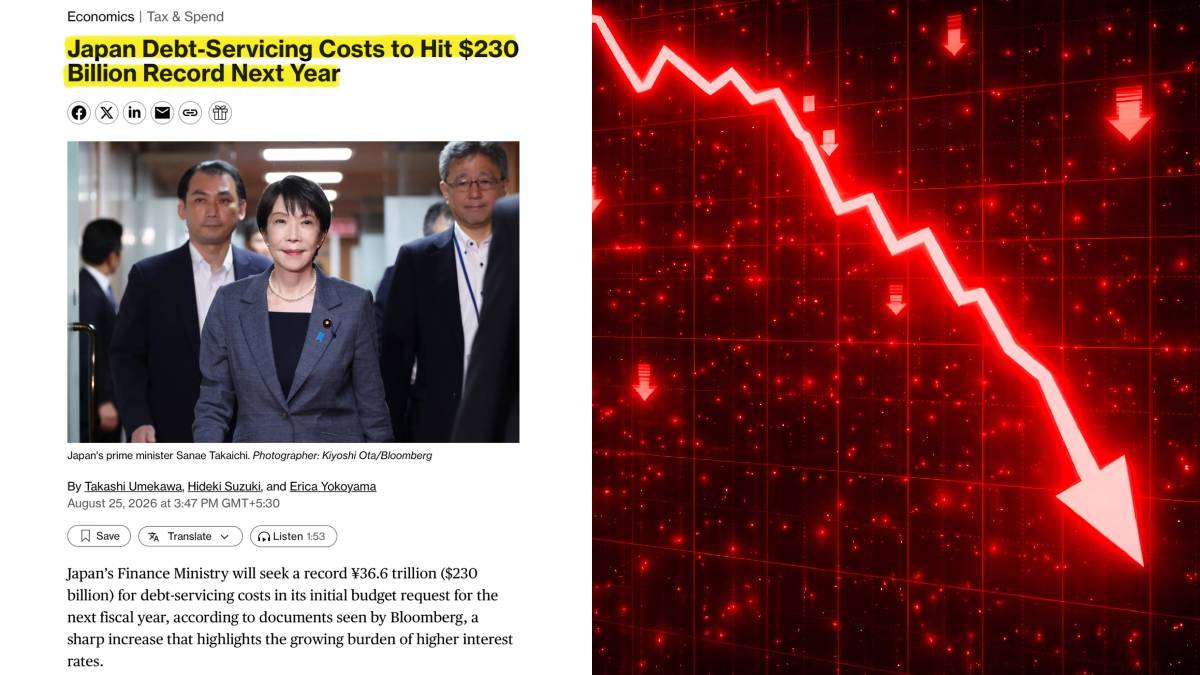
Japan is on the verge of a major increase in debt servicing expenses as the country’s Finance Ministry estimates debt-servicing costs will rise to a new record ¥36.64 trillion (or around $230 billion) and its debt-servicing costs will be 17.1 percent higher than the current fiscal year and reflect the growing pressure on Japan’s public finances as interest rates rise.
The debt-servicing bill will include the government’s payments on its outstanding bonds and interest and debt redemptions. Japan is also moving away from the ultra-low interest-rate environment that had kept borrowing costs relatively manageable for decades.
One of the main reasons for the increase is the Finance Ministry’s plan to use the assumed interest rate of 3.8% in debt-servicing costs when looking at the budget request for fiscal 2027. That would be the highest assumed rate in 29 years and a far cry from the 3% assumed in the budget for fiscal 2026.
The change reflects the rapid rise in Japanese government bond yields. Japan's 10-year government bond yield recently reached 2.945%, its highest level since the 1990s. Higher yields mean that new government debt and debt that needs to be refinanced may be more expensive.
It is important to note that the 3.8% figure is a budgeting assumption and not the interest rate applied to the entire outstanding debt in Japan. The existing government bonds carry their contractual coupon rates until maturity so the impact of higher rates will happen more slowly as debt is refinanced and new bonds are issued. Real debt-service costs will depend on future bond yields, refinancing requirements, issuance patterns and the final budget.
The mounting debt burden comes at an especially challenging time for Japan. The government also is preparing for a big fiscal 2027 budget, with ministries and government agencies expected to request over ¥130 trillion for the first time, compared with about ¥122 trillion in the current fiscal year.
Part of this increase in spending is because Prime Minister Sanae Takaichi’s policy of fiscal expansion is more expansionary, such as public investment projects. The government also intends to include some of its expenditures that have been covered, previously, by supplementary budgets in the first annual budget, potentially increasing the headline spending figure.
So this is a tricky balancing act for policymakers. Japan is trying to promote economic growth and investment while saddled with one of the biggest public debt burdens among advanced economies. Rising interest costs could mean less money will appear to be available to social welfare, infrastructure, defence and growth-oriented projects as well.
Bond market concerns about Japan's fiscal stance have been already brewing in the bond market. Rising long-term government bond yields are a combination of inflation, expectations for a further monetary-policy tightening and investors’ skepticism about the government’s fiscal direction in Japan.
And for the Bank of Japan the situation is a more complicated policy problem. The country has operated at extremely low interest rates for decades but inflation and changing economic conditions have pushed monetary policy to a new level of normalization. Higher policy rates can tamp down inflation, but they will also increase borrowings for a government with a huge amount of debt.
The impact goes beyond Japan’s economy. Japanese investors own some of the world’s biggest overseas assets. If domestic government bonds become more attractive because they have higher yields, some Japanese investors might tend to turn away from foreign bonds and other foreign assets. That could influence the global bond market and capital flows globally.
The ¥36.64 trillion projection is more than one budget figure. It is a structural change in Japan’s fiscal system, after years of low borrowing costs helped absorb the financial burden of its multibillion debt stock.
The government will finalize its budget requests by the end of August and the Finance Ministry will then review them and prepare a budget for the cabinet review in the latter half of the year. Then the final debt-servicing figure might be altered to the budget for fiscal 2027.
The key, of course, will be whether Japanese bond yields continue to rise. If borrowing costs remain elevated for longer, the government’s debt-service burden may continue to rise as older and cheaper debt is gradually replaced with more expensive borrowing.
Japan’s $230 billion debt servicing bill also shows the growing importance of interest rates to the country’s economic prospects. As debt costs increase by roughly 17% in a single year, governments will be increasingly under pressure to balance fiscal support and economic growth with the long-term sustainability of government finances.
Japan will be watched closely by investors as the country finishes its fiscal 2027 budget and markets assess whether the country can absorb growing borrowing costs without further burdening its already very heavy public finances.






Comments
Please to leave a comment on this article.