
Bank customers in India could face disruption in banking services after UFBU (United Forum of Bank Unions) called for a nationwide strike on 11th September 2026. The umbrella organisation of nine bank employees’ and officers’ unions has decided to go ahead with the strike in light of some pending demands like the implementation of five-day banking and differences around the performance-linked incentive scheme.
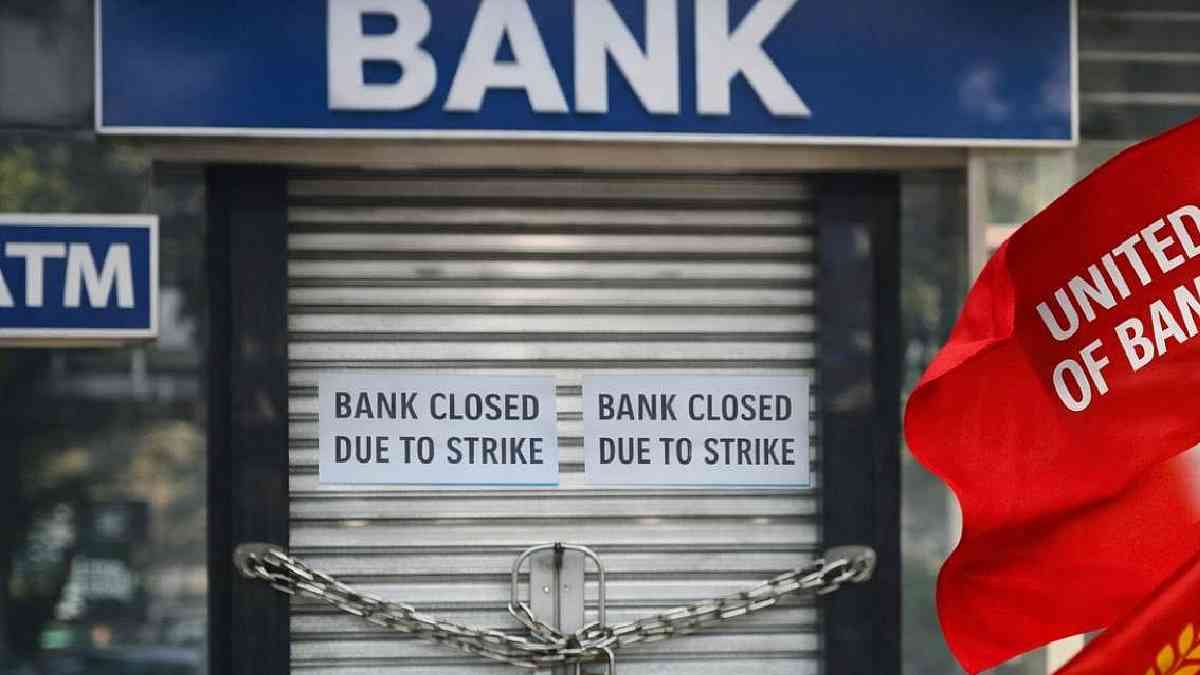
If the strike goes on as announced, then customers, especially those who rely on public sector banks, might experience disruptions around the strike date and the following holidays.
September 11 falls on a Friday, after the weekend. In addition, September 14 is a holiday in some states because of Ganesh Chaturthi. In that case, banking operations may not be able to work in a lot of the country.
Why are bank unions going on strike?
The main issues raised by the UFBU include the long-pending implementation of five-day banking, concerns for the government's performance-linked incentive scheme and several pension-related demands.
The unions have argued that five-day banking has already been agreed upon in principle and that the proposal should now be implemented.
According to the UFBU, the Indian Banks' Association (IBA) agreed on the five-day banking proposal under the 12th Bipartite Settlement and 9th Joint Note signed on 8 March 2024.
As a result, bank working hours from Monday to Friday would increase by around 40 minutes to compensate for the reduction in working days.
But the unions claim that the proposal has been pending with the government for more than two years.
Dispute Over Performance-Linked Incentive
Another major point of disagreement is the performance-linked incentive (PLI) scheme for bank officers.
The UFBU has opposed the government's approach for officers in Scale IV and above. According to the unions, the scheme differs from the understanding reached with the IBA.
The unions have argued that performance-linked incentives should be linked to the overall performance of individual banks rather than solely on individual performance.
Under the government's scheme, officers in Scale IV and above could receive PLI equivalent to as much as 365 days of basic pay, depending on their performance. The maximum is reportedly 15 days of basic pay plus dearness allowance for workmen employees and officers up to Scale III.
The matter is currently under conciliation before the Chief Labour Commissioner, and the unions have also said that the issue is pending before the Delhi High Court.
UFBU Raises Concerns Over Implementation
Bank unions have said the Department of Financial Services advised banks to implement the government’s PLI framework even as conciliation proceedings were pending.
According to the UFBU, payments under the government-backed scheme have already started in some banks.
The unions say the existing approach could disproportionately benefit a relatively small segment of senior officers and weaken what they say is the principle of uniformity in incentives across different employee categories.
The issue has thus become one of the key points behind the latest strike call.
Pension Demands also remain unresolved
Apart from working arrangements and incentives, bank unions have also raised several pension-related demands.
These include pensions being updated and improved, a uniform dearness allowance formula for pensioners and the option for employees covered under the National Pension System (NPS) to switch to the old pension scheme.
The unions have maintained that these demands have not been met by the authorities.
More Strikes Could Follow
The strike on September 11 may not be the only industrial action planned by the unions.
The UFBU has also threatened a three-day nationwide strike beginning September 28, coinciding with the half-yearly closure period.
In addition, the unions have warned of an indefinite strike from October 26 if their demands remain unresolved.
And if negotiations fail to get a resolution, the banking sector could face several periods of disruption in the next few months.
What could bank customers expect?
If the strike happens, customers could experience service interruptions through physical bank branches, especially at public sector banks. Cash deposits and withdrawals, cheque-related services, account-related requests and other branch-based activities may be affected.
Digital banking services such as internet banking, mobile banking, UPI and ATMs continue to work, but the availability of specific services can vary between banks and circumstances.
In the face of the proposed strike, customers with important banking work should consider completing branch-dependent transactions before the strike.
The situation could still change if discussions between unions, bank management and the government lead to a resolution or withdrawal of the strike call.
So far September 11 is the key date for customers, and if the unions' demands are not met, further industrial action can take place later in September and October if they are not met.






Comments
Please to leave a comment on this article.